
In 2024, 394 women were murdered while 258 died under suspicious circumstances in Turkey. In 2025, over 200 Turkish women were killed by men in 2025. While 297 women were found dead under suspicious circumstances. We Will Stop Femicides, a platform established after the brutal murder of Münevver Karabulut in 2010, has recorded over 2,000 femicides since 2021. UN Women describes "femicide" as a term that refers to intentional killing with a gender-related motivation, different from homicide where gender is not necessarily a key motivation. According to common trends, women and girls are most likely to be killed by a member of the family or those closest to them.
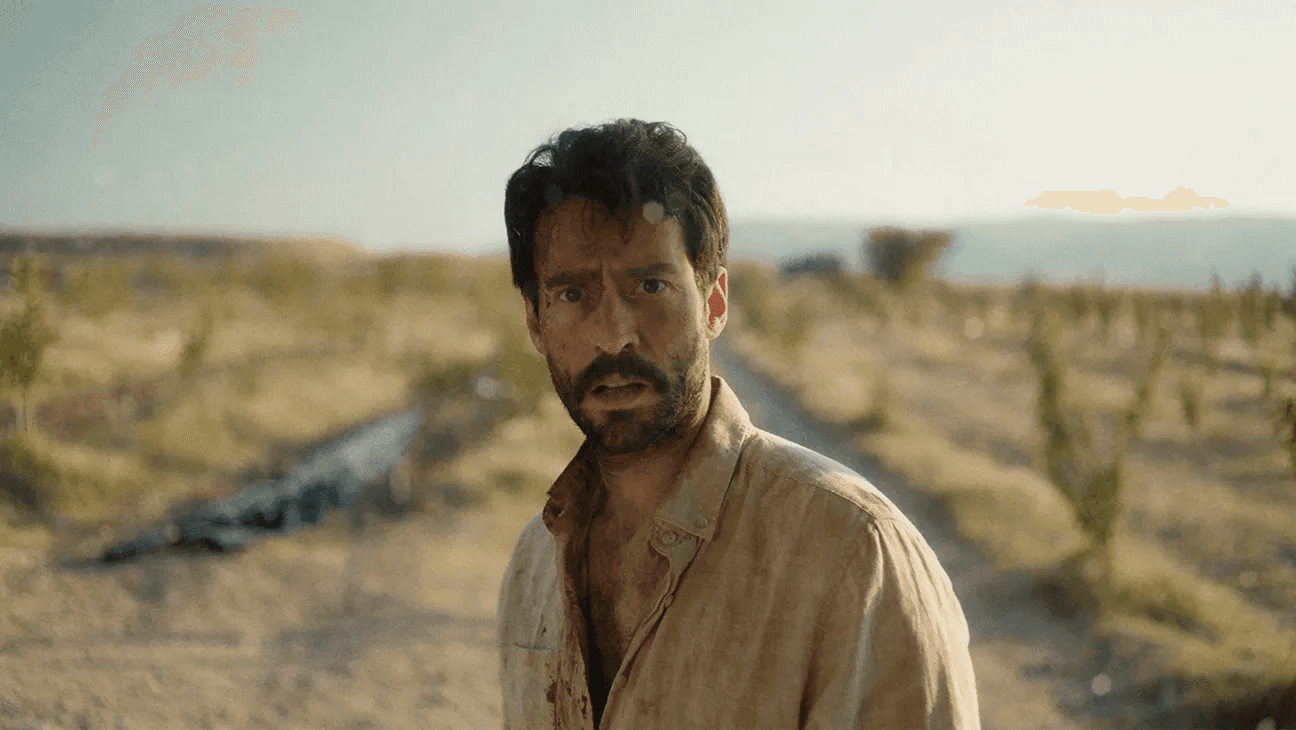
The Things You Kill (2025) is a deeply personal film from Iranian-born writer-director Alireza Khatami. These murders are not just numbers, they are real. And extremely personal. Going in blind, it was a deeply unsettling thrill to experience. I caught a screening at its premiere at the recent QC Cinema film festival. In my encounter, my predisposition led me to believe this was a film about the dead. To my shock, the film centered on grief instead. It establishes itself within cuts between sudden violence and mundanity, lending itself to the psychological thriller genre, but not without attempting to explain meaningful truths about femicide and women in Turkey; albeit from a male perspective.
Ali and his wife Hazar, speak of a dream where Hazar imagines Ali's father, battered and bloody. "I was at your dad's house," Hazar explains. "I was sleeping alone. Suddenly, someone knocked on the door. (...) I went to the door. I opened it up, and I saw your dad. But his face. (...) He just passed me by. (...) He said I'll sleep here for a bit, then he said. He said: Turn off the light." The film begins with a dedication from Khatami: for my sisters. Ali's ailing mother answers the gate with her walker. She is slow to move, and now her son must visit her to take care of her. The elderly mother feels ashamed about her son bathing her. She insists on doing this herself. As she complies, he bathes her, and they discuss. "Even a veterinarian is a doctor," referring to Hazar’s work. When we first meet the father at the start of the film, he argues with Ali. "Condolences," sisters of Ali tell him. "May this be your last sorrow."
In the film, grief is only for the living, and more often for women. Ali's sister says something similar. "Sadness and sorrow are only for women." In a scene between a vulnerable brother and sister, in reference to their mother's silence and lived abuse, this scene breaks me. In another titular scene, we meet the gardener (Reza) who is seen through a literal and philosophical mirror. Reza serves as a shadow to Ali and Hamit, his father, a representation of the generational trauma he endures as both person and man. When Ali asks his father as to what time his mother died, he replies how he discovered his mother's body. "I came at 11. There was a smell. (...) I saw her lying in the corner." With further escalation, the conversation implicates Hamit in femicide. "Don't say my wife," replies Ali, an angry son. "Say my cow."
The Things You Kill asks us what we are willing to kill. In a cinematic landscape of leading women, what is interesting about the protagonist is how Khatami chooses to center the perspective of the film as male. The Things You Kill reveals even more by being an autobiographical piece. Not only is the story truthful, but it is not easy to watch. Neither is it a comfortable narrative for women. As it grounds itself in the very real experiences of Turkish femicides, we are forced to grieve our own depravities as human beings. Or perhaps, as men. Are we willing to kill our sorrows? Are we willing to bury the generational secrets of our bloodline? Are we willing to get rid of our anger? Are we willing to suffocate our silence? It is not the dead, though they may suffer, that must carry what we call: grief. In the end, these things do not simply pass quietly; they must approach a violent end.
1 Ruth Michaelson and Beril Eski, “‘There’s No Way My Daughter Would Have Jumped’: Why Are so Many Turkish Women Falling to Their Deaths?,” the Guardian (The Guardian, January 31, 2026).
2 SCF, “Some 2,000 Femicides, Suspicious Deaths in Turkey since Withdrawal from Istanbul Convention - Stockholm Center for Freedom,” Stockholm Center for Freedom, March 21, 2024.
3 “Five Essential Facts to Know about Femicide | UN Women – Headquarters,” UN Women – Headquarters, November 25, 2025.
4 Luke Gorham, “TTYK_Poster_Still_00125367,” In Review Online, November 13, 2025.

Related Articles

/
Arianne Dela Cruz, Christine Laza, Erin Brigino, Dara Villaflor, Ren Eñano & Matthew Manalili