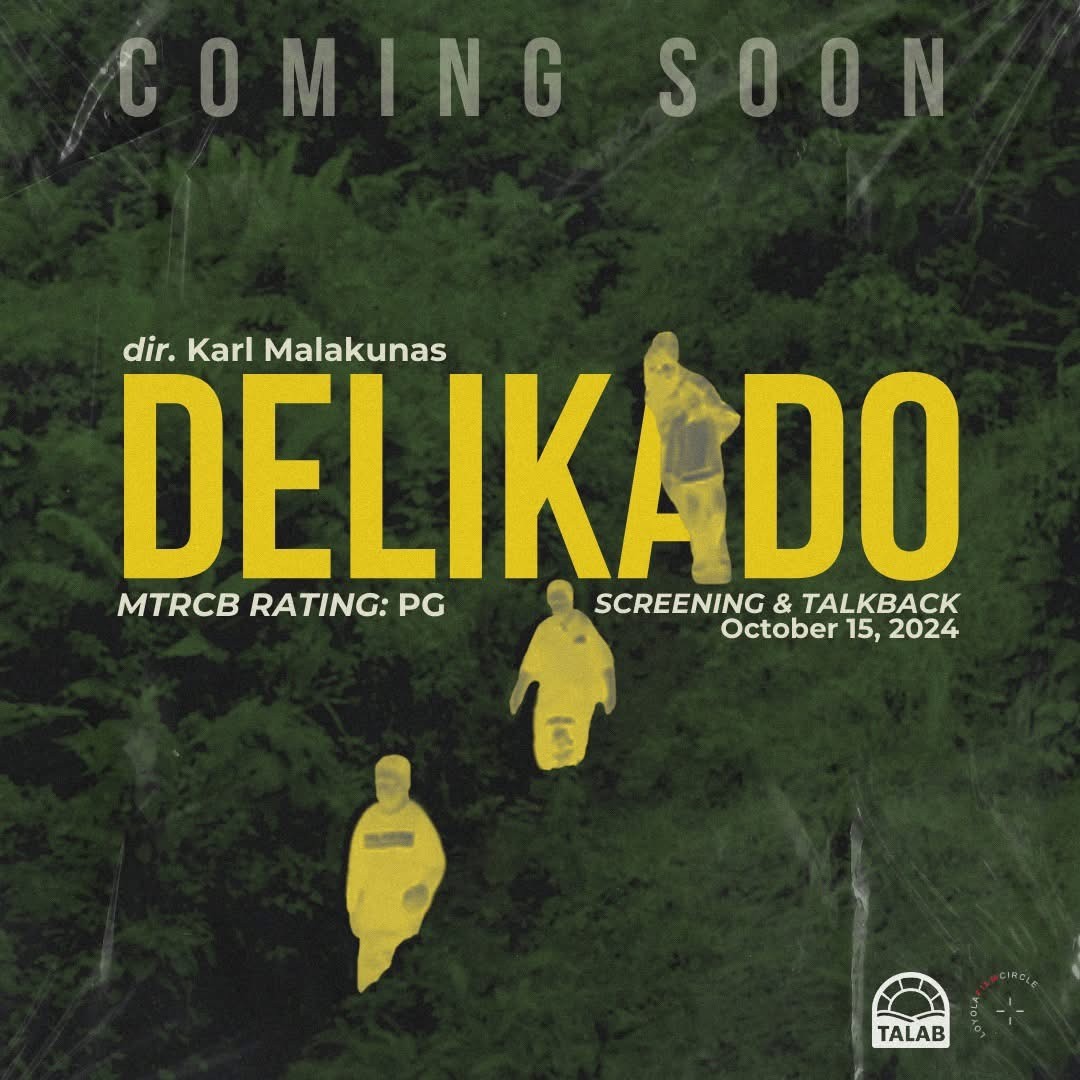
Palawan, a picturesque island of idyllic beaches and breathtaking sights, finds itself colored a deep crimson from the unjust murders of native islanders seeking to protect the island they call home. Rampant deforestation, fishing, and mining scourge the island, as urbanization rapidly expands while the concerns of native islanders are put aside for the sake of commercial appeal. How can one sit still and watch as their home tears itself from the inside? In the face of these overwhelming circumstances, a collective springs forth to meet these challenges as a last effort to defend what is considered the “The Last Frontier” of the Philippines.
This is Delikado, a documentary following the eco-warriors fighting for decades on end to protect and preserve Palawan’s precious ecosystem. The Loyola Film Circle (LFC), in collaboration with ActiveVista, screened the Emmy-nominated documentary as part of the annual Talakayang Alay sa Bayan (TALAB) event. In line with this year’s theme of Integral Ecology: Caring for Our Common Home, which discusses important issues concerning our environment along with a call for action upon the drastic changes that reflect our rapidly declining climate.
Delikado follows the three key intrepid figures who work tirelessly to preserve the ever-growing fragility of Palawan’s ecosystem. Directed by Karl Malakunas, a journalist for Agence-Free Presse based in Manila, who was already going to cover a story in Palawan until his contact had been found shot and killed. Despite the situation, Malakunas went to Palawan and investigated the murder of his contact and eventually uncovered the deep-seeded corruption perpetuated by government complacency. The film sets you shoulder-to-shoulder with para-enforcers with chaotic hand-held and gritty POV shots that are contrasted by framed takes of these heroic vigilantes living their day to day lives and going home to their families.
We are first introduced to Bobby Chan, Juris Doctor, Ateneo alumni, and the Executive Director of the Palawan NGO Network Inc. (PNNI), who has been at the helm leading and enabling the many eco-warriors that volunteer to halt the illegal operations occurring across the island. These vigilante operations are led by their head para-enforcer, Tata, who had joined the military at a young age to protect Palawan against communist and Muslim insurgencies but was instead assigned to illegally cut down logs. Seeking redemption, the audience follows him against the threat of death as he and his fellow para-enforcers confront illegal loggers equipped with guns with nothing other than the concept of citizen-arrest.
Many of these eco-crusaders have suffered heavily, bearing scars from the chainsaws they confiscate, and some have even lost their lives. Kap Ruben is one of these para-enforcers, and had unfortunately lost his life during the filming process. This documentary is dedicated to him, and the work of him and his fellow environmental activists. The total breadth of their work comes into full perspective with PNNI’s Environmental Enforcement Museum. This museum features various seized chainsaws, fishing boats, rifles, and illegal fishing equipment from their operations over the years displayed en masse, including the standing testament to their work—a tall tree-like structure made entirely of chainsaws.
The last figure the documentary follows is Nieves Rosento. As a long time environmentalist, she has championed the protection of Palawan’s ecosystem and the reclamation of environmental and human rights of the province. The documentary follows her story as she attempts to be re-elected as mayor of El Nido, but finds herself rigged against threats of death and allegations of drug-use while her opponent buys and bribes voters. Her loss in 2019 shows the total extent and influence of Rodrigo Duterte’s war on drugs, not only to excuse the killings of innocents but as well as to shut down any efforts of goodwill in the political sphere. Rosento, in the heat of loss, still finds herself unwavering as she geared herself toward becoming governor of Palawan instead. Today, that dream may not have been a success, but Rosento’s campaigning and championing of environmental rights have led to long-term impacts in the efforts to recognize Palawan’s ecological issues to prevent further obscuration.
The fight for Palawan still ensues, and in many ways, it has grown even more difficult as PNNI’s influence has weakened with the recurring exploitation of Palawan’s natural resources and rapid urbanization as a tourist destination. Today, all three figures presented in Delikado have somehow left no footprint after the release of this film. Bobby Chan was declared persona non-grata and is unable to return to the province island while Tata is no longer the head para-enforcer. While, Nieves Rosento had a quiet exit following her loss in 2019 and did not run for Governor of the province in 2022.
As the muzzle around PNNI tightens, so too does the grip of control on the island. However, this is not an isolated issue. For instance, refugees of Bugsuk island have found sanctuary in the university as Ateneo Para sa Bugsuk has given these displaced individuals a platform to voice their concerns regarding their displacement from their native home.
After the screening wrapped, the event transitioned to the talkback portion with featured speaker, Jing Barrios, an environmental defender himself and Indigenous People’s rights advocate. Sitting alongside him is ActiveVista representative Mark Fortaleza. As the floor opened for questions, an apparent theme had risen from the many Ateneans whose emotions were heightened as they witnessed the countless injustices that continue to plague the nation; What can we do now? I, as an individual person, or us, as a student-body and community - What can we do?
Jing Barrios, replied by simply encouraging the audience to volunteer—to become active in the discussion and dissemination of these issues. As these advocacies grow larger and larger, the more that the right people will be able to see them and take action. Caring about these issues and the lives being affected is the biggest first step anyone can take.
There is a crucial necessity in the action of an individual and the efforts to grow a collective. Delikado had proved that more than anything, despite the pressure and threat of death, their voices had reached an international stage.
The avenues in which one would start is left more unseen in the eyes of those who do not seek it, and the discussion within the talkback session teaches that seeking it out is the most important step. Our seeking and the actions that follow thereafter, is Caring for Our Common Home.

Related Articles
/
Dara Villaflor
/
Ava Dumaup